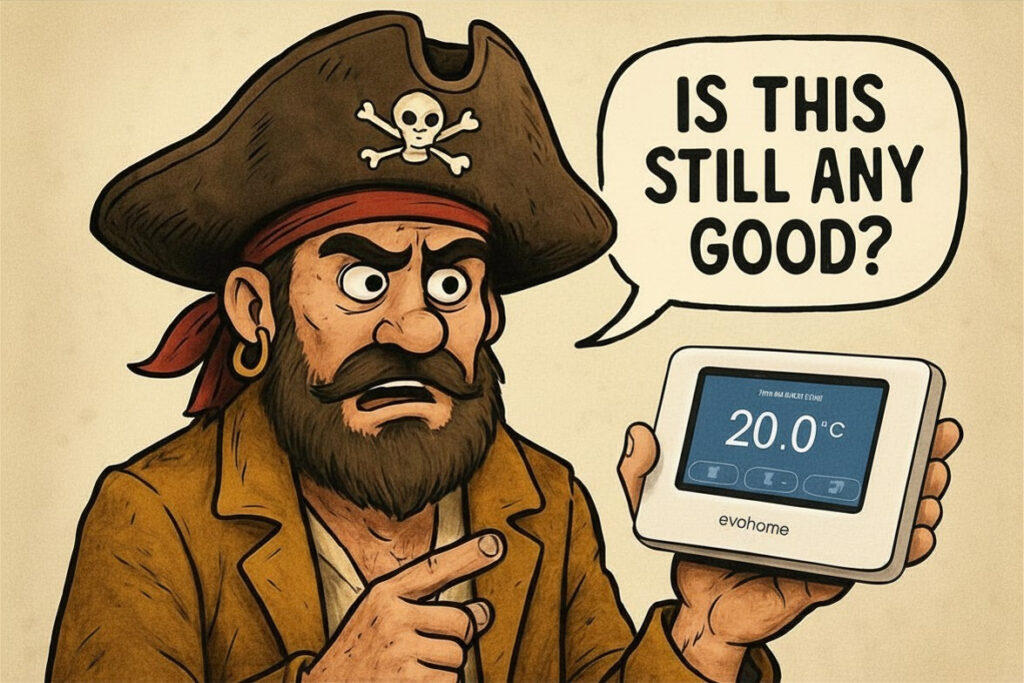
Launched in 2014, the third‑generation Honeywell evohome marked a major leap for the brand, because it introduced a full redesign with built‑in Wi‑Fi and a modernised interface that replaced the earlier ATC928G2000 model. Since then, however, a lot has changed. Honeywell spun off its home‑comfort division into Resideo in 2018, and the firmware has continued to evolve, yet the hardware itself hasn’t received a meaningful refresh in more than a decade. As a result, many homeowners and installers now wonder how well this system holds up in today’s fast‑moving smart‑heating market.
So in 2026, with heating‑oil prices rising and competition increasing, does this now‑12‑year‑old flagship thermostat still make sense to buy? That’s exactly what we break down in our latest blog post.
What is evohome?
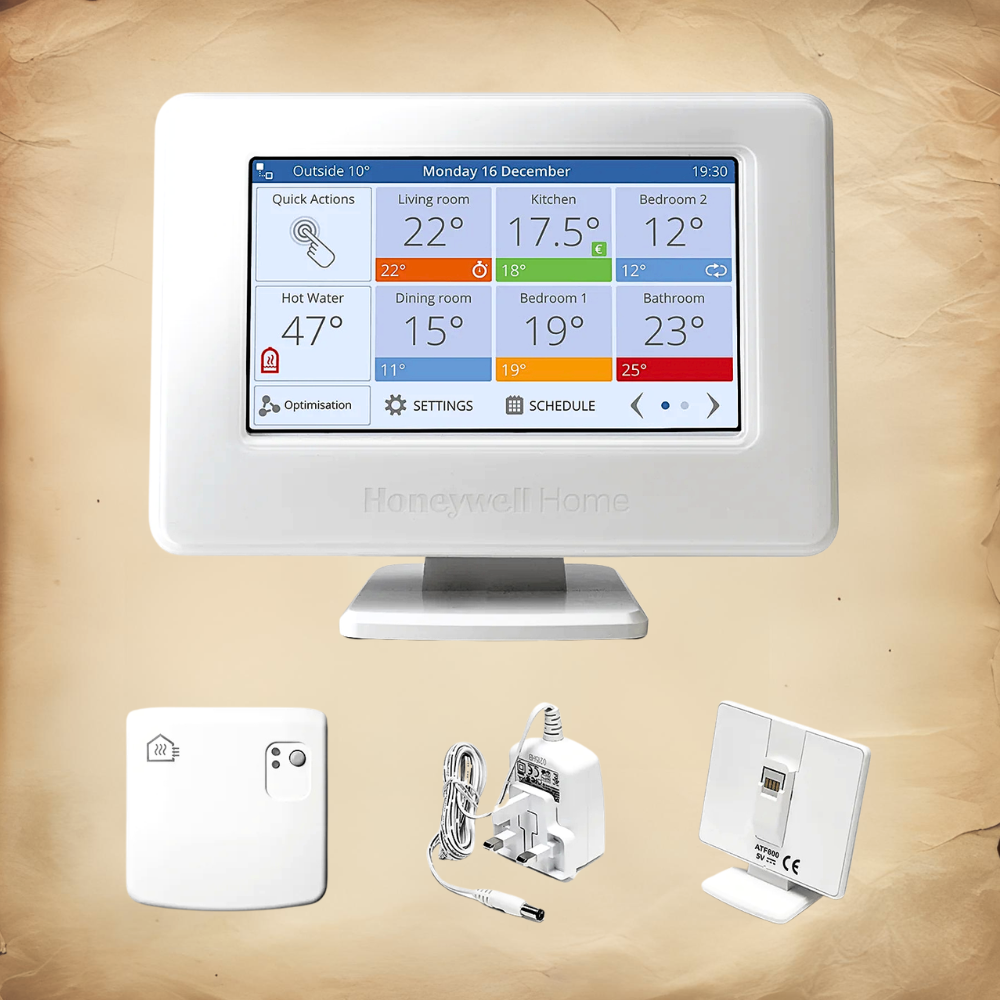
Honeywell Home evohome gives you smart, multi‑zone heating control with room‑by‑room temperature management across up to 12 zones. You can start quickly with the Connected Thermostat Pack, which includes the Wi‑Fi‑enabled evotouch controller, a plug‑in table stand, and the BDR91 wireless relay that links the system to your combi boiler. This pack creates the core of your evohome setup, and you can expand it easily by adding radiator controllers or underfloor heating modules
How does evohome work?
Honeywell Home evohome works just like a standard smart thermostat when you use it in single‑zone mode. If you’ve ever used a Honeywell CM900 or CM700 programmable thermostat, you’ll recognise the core idea immediately, because evohome acts as the modern, Wi‑Fi‑enabled upgrade with a cleaner interface and several extra smart features. In fact, even the well‑known Nest Learning Thermostat took inspiration from earlier Honeywell controls such as the CM927 and the original evohome system.
However, evohome really pulls ahead of competing products once you switch to multi‑zone control. You can create a simple upstairs/downstairs setup by adding a DT4R, and you can manage homes with multiple radiators by fitting HR91 or HR92 controllers for room‑by‑room precision. Furthermore, if you run an OpenTherm boiler, replacing the standard BDR91 relay with the R8810A OpenTherm Bridge unlocks load compensation, smoother modulation, better comfort, and improved efficiency
Why evohome still stands out in 2026
- 🏴☠️ Would I still buy evohome in 2026
- Evohome remains worth considering in 2026 because it delivers something many modern smart thermostats still struggle to match: reliable, flexible, whole‑home zoning that works in real UK heating systems. Although the hardware is ageing, the system’s core strengths continue to hold firm. It still offers stable RF performance, broad compatibility with S‑Plan and Y‑Plan setups, and the ability to manage up to 12 independent zones with radiator‑level precision. When you pair it with HR91 or HR92 controllers—or with an OpenTherm Bridge—it can outperform many newer “single‑zone‑first” thermostats in both comfort and efficiency.
- ⚓ Why evohome continues to hold its ground
- Evohome’s longevity comes from solving real‑world problems that many newer systems continue to overlook. UK homes often combine radiators with underfloor heating, rely on older pipework, use hot‑water cylinders, and span multiple floors. Systems like Nest and Tado focus heavily on single‑zone optimisation, pay-for-play learning algorithms, or geofencing; however, they rarely offer the same depth of zoning or compatibility. Evohome’s approach—dedicated controller, robust RF, and modular components without addional fees—remains far better suited to complex heating layouts.
- 🔧 How it compares to newer smart thermostats
- Modern systems such as Nest and Tado excel in simplicity and app‑driven features, yet they typically manage only one or two zones. Evohome, by contrast, was built from day one for multi‑zone control, allowing every room to run its own schedule and temperature. This gives homeowners more precise comfort and reduces wasted energy by heating only the rooms in use. Furthermore, Resideo’s ongoing support—including features like Advanced Load Scaling™ and heat‑pump compatibility—keeps evohome relevant even as the market continues to evolve.
- 🏠 Final takeaway
- For homeowners who want room‑by‑room control without replacing radiators or rewiring the house, evohome remains one of the most practical and proven solutions available. Installers also value its predictability, modular design, and long‑term reliability, which keep it a trusted choice even as newer systems enter the market. Evohome may not be the newest or flashiest system in 2026, yet it still delivers what matters most: comfort, control, and compatibility in real homes.
Comparision Table
| evotouch Model | ATC928G1000 | ATC928G2000 | ATC928G3000 |
|---|---|---|---|
| Launch Year | 2010 | 2012 | 2014 |
| Wi‑Fi Connectivity | No | No | Yes (built‑in) |
| App Control | Not supported | Yes – Via RFG100 & Total Connect Comfort | Yes – Total Connect Comfort |
| Display | Early resistive touchscreen | Improved colour resistive touchscreen | Updated colour resistive touchscreen with modern UI |
| Processor Speed | Slowest | Improved | Fastest and most responsive |
| RF Performance | First‑gen RF | Improved RF stability | Most stable RF with better range |
| Power | Table stand + 3‑pin plug | Table stand + 3‑pin plug | Table stand + 3‑pin plug |
| Radiator / UFH Compatibility | HR80 / HCE80R & HCC80R | HR80 & HR92 / HCE80 & HCC80R | HR80, HR91 & HR92 / HCE80, HCC80R & HCC100 |
| Firmware Updates | None | RFG100 only | Ongoing firmware support |
| Multi‑Zone Support | Up to 8 zones + hot water via evohome Hot Water Kit | Up to 12 zones + hot water via evohome Hot Water Kit | Up to 12 zones + hot water via evohome Hot Water Kit |
| OpenTherm Support | Via R8810A OpenTherm Bridge | Via R8810A OpenTherm Bridge | Via R8810A OpenTherm Bridge |
| Smart Functionality | Optimum Start & Stop | Optimum Start & Stop | Optimum Start & Stop, Advanced Load Scaling, Warm Weather Saver, Cold Weather Boost & Heat Pump Compatibility |
Meet The Product
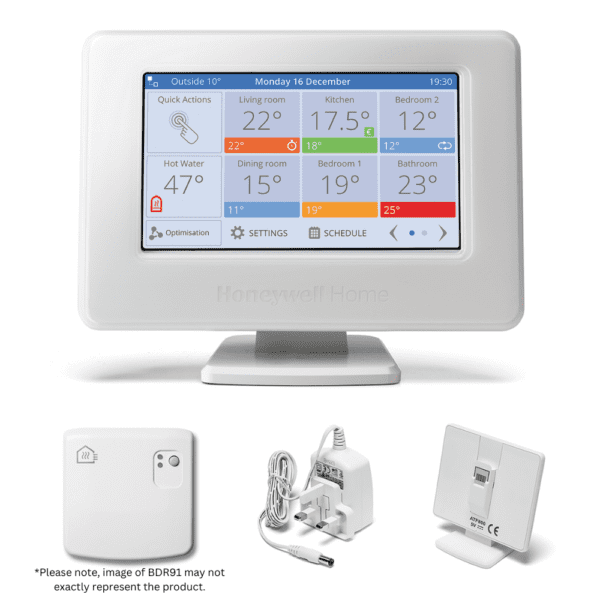
Private: Honeywell Home evohome Connected Thermostat Pack (ATP921R3100)
Installer Tips
📡 RF communication and device placement
Honeywell Home evohome communicates over the 868 MHz RF band, using direct point‑to‑point signalling between the evotouch controller and each connected device. Because this RF system depends on clean, unobstructed communication, performance can drop when the controller or the BDR91 relay sits too close to other RF‑emitting devices or large metal objects. As a result, good positioning remains one of the most important factors in achieving a stable and reliable evohome installation.
⚙️ Relays, wiring behaviour, and system configuration
The BDR91 wireless relay box runs from a 230 V supply—usually taken from the boiler or wiring centre—and uses a volt‑free SPDT relay to switch the boiler on and off. You can also configure it for a 230 V switched‑live output by adding a link between the second live terminal and terminal A. This setup is common in older systems, and the relay is built to handle either configuration safely and consistently.
🌡️ Using the evotouch as a room sensor
The evotouch controller can act as the temperature sensor for a single heating zone, although this isn’t ideal when you use it as a multi‑zone hub or move it around frequently. In these situations, a dedicated wireless room sensor such as the DT4R provides far more accurate and stable temperature readings. This becomes especially important in busy households where the controller is often handled or relocated.
🔥 OpenTherm, hot water priority, and X‑Plan
Homes with an OpenTherm system boiler—for example, an Intergas HRE SB—get the best results when evohome runs with hot water priority. Although evohome’s software supports PDHW logic, a mechanical priority setup usually delivers more reliable behaviour. You can achieve this with a 3‑port diverter valve or by using an X‑Plan arrangement.
X‑Plan, which I personally developed for evohome back in 2017, uses a Normally Open 2‑port valve on the heating circuit and a Normally Closed 2‑port valve on the hot‑water circuit. It behaves similarly to S‑Plan but always maintains a flow path, making it ideal for OpenTherm modulation and systems that require two different flow temperatures. X‑Plan works particularly well in single‑zone heating systems, where its simplicity and reliability stand out.
FAQ's
Can evohome operate UFH and radiators at the same time?
Yes. evohome is a multi-zone and multi-technology heating controller. It can control radiator zones at zone valve level, using a DT4R and BDR91 wireless relay box, or it can control the whole heating zone at the radiator level with HR91 or HR92 radiator controllers. If you want to add multi-zone UFH at the same time, then this can be achieved with a HCC100 and DT4R thermostats in each of the zones. Just bear in mind each evotouch controller only supports 12 heating zones.
I want a new Worcester combi boiler. Can I use evohome on OpenTherm?
No. Worcester Bosch boilers do not natively use the OpenTherm protocol and therefore do not support load compensation with evohome. If you are looking at evohome, maybe research a boiler brand that does support OpenTherm (Intergas Xclusive or Viessmann 100-W for instance). We blogged about the key benefits of OpenTherm here, so I would recommend looking at a boiler that properly supports OpenTherm.
Is evohome easy to fit?
Yes. Belive it or not, evohome is very easy to fit. However, like many other heating controlllers, evohome is a product that uses 230 volts and can in some circumstances, require taking the casing apart on a gas appliance. If you are not a competent heating installer (and in the instance of fitting evohome to a gas appliance in the UK, a GAS SAFE registered engineer), then you should not be fitting evohome. Please obtain the services of a heating installer who is qualified and competent